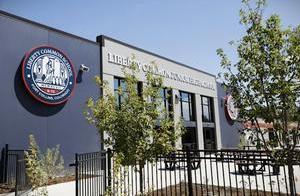
When Liberty Common School added a second elementary campus in 2022, the new classrooms filled almost immediately.
Those additional K–6 students would eventually need somewhere to go for junior high, and Liberty Common’s existing space for grades 7 and 8 was already limited. Rather than wait for enrollment growth to catch up with available classrooms, school leaders began planning ahead.
The result is a new standalone junior-high campus that opened in phases beginning in fall 2025 and was completed in August 2026, creating dedicated space for grades 7 and 8 while freeing up capacity at Liberty Common High School.
A $1,799,689 federal Charter Schools Program grant through Great Schools Colorado helped Liberty Common equip the new campus while giving leaders greater flexibility to invest in other school resources where they were needed most.
Planning for the Students Coming Next
Liberty Common, a K–12 public charter school authorized by Poudre School District R-1, has served Fort Collins since 1997.
In 2021, its parent-led Board of Directors voted to increase elementary capacity by approximately 65% by leasing a second facility in southwest Fort Collins. Known as the Aristotle Campus, the additional classrooms filled quickly. The school purchased the property in December 2024.
“The added classrooms filled immediately,” says Headmaster Bob Schaffer. “Naturally, those new students matriculated to junior-high grades and in such numbers that exceeded the capacity of our junior-high classrooms previously housed at our high-school campus.”
Liberty Common purchased another property immediately southwest of its original Plato elementary campus to create a standalone junior high. Its location also keeps students close to existing resources, including Liberty’s track, lighted soccer field and elementary gyms.
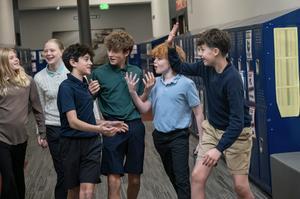
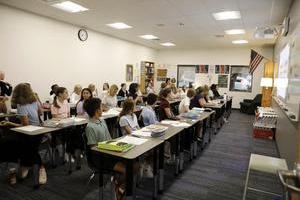
Phase One opened in August 2025 with the junior high’s main classrooms. A second phase significantly expanded the facility and connected its buildings into a single structure. The completed campus opened in August 2026 with large classrooms, dedicated science labs, music and art rooms, a competition-size gymnasium, lunchroom and special-education spaces. Led by Principal Kathleen Kearney, the campus serves Liberty Common’s seventh- and eighth-grade students.
“Building a standalone junior-high campus accommodated the planned growth and created additional enrollment opportunities by freeing up lots of space at our high-school campus,” Schaffer says.
Equipping a New Campus
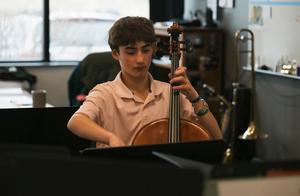
Liberty Common’s $1,799,689 Great Schools Colorado award represented approximately 74% of the $2.43 million project. Grant funding supported the furniture, curriculum materials, technology and specialized equipment needed to bring the new junior-high campus to life, from band instruments and science-lab equipment to 3D printers and special-education resources. It also supported enrollment communications and some staff training.
Just as important, the grant gave Liberty Common greater flexibility in how it used other school resources.
Schaffer says having many of the new campus’s necessary expenses covered allowed the school to make “better budgeting and appropriations decisions around capital expenses associated with facility expansion and planning.”
That flexibility allowed Liberty Common to direct other resources toward priorities including facility enhancements and higher faculty compensation.
Growing Without Diluting What Works
More seats, however, were only one measure of a successful expansion.
For Liberty Common, growth also meant protecting the academic model and school culture it has built over nearly three decades. As new students, families and employees joined the school community, Liberty Common became more intentional about defining what should remain constant.
“We’ve doubled down on codifying the school’s vision, mission, policies, and practices to better ensure academic quality and school culture will endure unimpaired well into the future,” Schaffer says.
At the same time, the new campus created opportunities to expand what Liberty Common can offer junior-high students. The school continues its Core Knowledge curriculum, while dedicated spaces provide room for additional electives, science instruction, music, art, athletics and other co-curricular activities.
Even as Northern Colorado faces declining birthrates and fewer school-age children, Liberty Common’s waiting list tells a different story.
“Our waiting-list lottery still indicates high regional demand for Liberty’s academic offerings — classically oriented, Core Knowledge curriculum, and an accelerated college-preparatory secondary strategy,” Schaffer says.
Nearly three decades after Liberty Common first opened, its newest campus gives the school room to respond to that demand — while staying focused on the academic model and school culture that brought families to Liberty Common in the first place.
Frequently Asked Questions
1. What is Great Schools Colorado?
Great Schools Colorado is a five-year, $77 million federal Charter Schools Program grant awarded to the Colorado League of Charter Schools to support the creation, replication and expansion of high-quality public charter schools across Colorado.
2. How did Great Schools Colorado support Liberty Common School?
Liberty Common received a $1,799,689 Great Schools Colorado award to support its junior-high expansion. The grant represented approximately 74% of the $2.43 million project and helped fund furniture, curriculum materials, technology, science and music equipment, special-education resources and other needs for the new campus.
3. Why did Liberty Common expand at the junior-high level?
After Liberty Common increased its elementary capacity by approximately 65% in 2022, those additional students began moving toward the junior-high grades. The standalone campus created room for that growth while freeing up additional capacity at Liberty Common High School.
4. What does Liberty Common’s new junior-high campus include?
The completed facility includes large classrooms, dedicated science labs, music and art rooms, a competition-size gymnasium, lunchroom, special-education spaces and other areas designed to support junior-high academics and activities.